

BIS 2461: John Pickard's The Gardener of Aleppo
Editor's Choice
'Covering 30 years of composer John Pickard's career, these well-chosen works convey his concerns with emotion and events; the Nash Ensemble understand his sound world intimately'
Gramophone September 2020
'Around Schubert' at Wigmore Hall
'The Nash Ensemble series of concerts Around Schubert have reached a substantial midway point.
The works of a number of great composers were included in a concert that was studied with
delicacies as a plum pudding on a cold December evening'
Classical Source, December 2019
German Romantics - Nash 2018-19 Series at Wigmore Hall
'Every recital of the German Romantic series is a gem of programming, typical of the Nash's imagination and breadth'
Classical Source
German Romantics - Nash 2018-19 Series at Wigmore Hall
"a unique ensemble at the heart of British music making"
Hugh Canning, Sunday Times
Nash Inventions, 12 April 2019, Wigmore Hall
"…immaculate and enthralling concert … The peerless Nash Ensemble … A formidable workout for two virtuosos – the viola player Lawrence Power and cellist Adrian Brendel…"
Richard Morrison, The Times (5 star review), 13 April 2019
Nash Inventions, 12 April 2019, Wigmore Hall
"One of the great thing about The Nash Ensemble, Britain's most revered chamber group, is its loyalty. The group's artistic director, Amelia Freedman doesn't pick composers up and then drop them when the fashion changes. She sticks with them, nurturing their careers over decades … The terrific performance from violist Lawrence Power and cellist Adrian Brendel made everything crystal-clear"
Ivan Hewett, The Daily Telegraph, 14 April 2019
Nash Inventions, 12 April 2019, Wigmore Hall
"The Nash Ensemble opened up their inner workings to their audience, conjuring a spirit of revelation and excitement … Knussen's Study for Metamorphosis for solo bassoon was played with terrific agility and gloriously rich tone by Ursula Leveaux … Birtwistle’s Duet for Eight Strings for viola and cello, searching lines and exploratory textures and harmonies were exquisitely delineated by Lawrence Power and Adrian Brendel."
Claire Seymour, Opera Today, 16 April 2019
Dohnányi Chamber Music - Hyperion Records CDA 68215
"A brilliant display of flexible playing from one of the leading chamber ensembles of our time in repertory which few other ensembles have ever managed to bring off with such élan … what has characterised everything the Nash Ensemble has done since their very earliest days, is a sense of absolute joy in music making and a passion which glows out of every single note they play. If we might reasonably expect a certain predictability to have crept into their performances after half-a-century at the very top of their game, nothing could be further from the truth with this invigorating and gloriously immersive journey through three very different chamber works by Ernö Dohnányi… it is all brilliantly played. It makes for utterly and completely compelling listening"
Marc Rochester, musicweb international, August 2018
Dohnányi Chamber Music - Hyperion Records CDA 68215
"Any recording from the renowned Nash Ensemble is worth of attention, and their latest, on Hyperion, featuring chamber works by Ernö Dohnányi, does not disappoint… Here, the Nash combine Dohnányi's familiar Serenade for string trio in C major with two rewarding, lesser-known works: the String Quartet No.3 in A minor and the Sextet for piano, clarinet, horn and string trio in C major. Both pieces require virtuosic ensemble playing, spiced with a mischievous sense of fun. The Nash have both in abundance in this warm-hearted, generous recording. Give it a try."
Stephen Pritchard, The Guardian, May 2018
Dohnányi Chamber Music - Hyperion Records CDA 68215
Five Stars
"… all virtuosos of course, their teamwork spotless, the clarity and projection vivid… Richard Watkins's horn-playing is immaculate, ripe as required, and every note Ian Brown contributes is charismatic - the performances are impressive and delightful, sensitive and full of panache."
Colin Anderson, classicalsource.com, July 2018
Dohnányi Chamber Music - Hyperion Records CDA 68215
"The Nash Ensemble dig into Dohnányi's Serenade (1902) with gusto, relishing the music's myriad felicities… their performance is rife with character and incident, and absolutely riveting in its own right. I love the theatrical way they sigh and sob at 2'00" in the fourth movement, for example. And in the rambunctious finale, especially, their playing conveys a frisson that's unusual for a studio recording. The Nash's performance of the Third String Quartet (1926) is more impressive still. Right from the first surging phrase - which froths and spits like a crashing wave - they grasp the emotional meaning of the composer's agitato e appassionato directive… If you've never taken to Dohnányi's music before, these performances should win you over. If you're already a convert, you'll want this."
Andrew Farach-Colton, Gramophone, June 2018
Dohnányi Chamber Music - Hyperion Records CDA 68215
"The Nash Ensemble's high voltage interpretation serves the music well, having tremendous physical impact and bringing an unusual, urgent intensity…
The Nash Ensemble triumphantly surmounts all the technical challenges while projecting absolute enjoyment of and devotion to the music."
Five stars for Performance and Recording
Erik Levi, BBC Music Magazine, July 2018
Nash Inventions at Wigmore Hall, 21 March 2017
"There were three premieres - two world and one first for London - in the latest edition of the Nash Ensemble's showcase of contemporary British music, as well as return visits to three other pieces by Huw Watkins, Colin Matthews and Julian Anderson… Simon Holt's wind quintet commissioned by the Nash offered something strikingly different… in It Rains, a new work by Colin Matthews, baritone Roderick Williams sang with perfect guileless purity."
The Guardian, March 2017
Nash Inventions at Wigmore Hall, 21 March 2017
"The playing was faultless and the writing fluent…"
The Times, March 2017
Bruch String Quintets and String Octet - Hyperion Records
"This is a superb account. The Nash Ensemble have a natural feeling for the music's ebb and flow, and while they're not afraid of big gestures… they play beautifully as an ensemble, with players responding to each other, a real feeling of intimacy. Lawrence Power's viola sings through the texture, and Stephanie Gonley, on first violin, never lets the alla ungarese brilliance of the finale turn into a mini-concerto… The Nash Ensemble go at it with magnificent ardour and sweep, and bring an affecting tenderness to the slightest of Bruch's late chamber works, the Mendelssohn-like Quintet in E flat. Together, these performances go straight to the top of a not exactly crowded field; in fact this disc needs to be heard by everyone who loves Germany Romantic chamber music."
The Gramophone, March 2017
Bruch String Quintets and String Octet -Hyperion Records
"The always rewarding Nash Ensemble add warmth and grace to the sprightly String Quintet in Eb major and bring verve and attack to its edgier A minor companion, but it is in the magnificent String Octet that the players finally allow the sun to truly shine. Recommended.
The Observer, March 2017
Wigmore Hall, 21 January 2017
"Another Mahler Symphony was on offer at Wigmore Hall. The Nash Ensemble under Martyn Brabbins, with soprano Lucy Crowe, presented the Fourth Symphony in Erwin Stein's deft 1921 reduction of its playing forces to 13. Nothing of the essence of the work, and little of the detail, seemed lost, and the hall resounded with rare symphonic grandeur."
The Sunday Times, February 2017
Wigmore Hall, 22 October 2016
"No European Capital has a richer cultural heritage than VIenna and for the Nash Ensemble's six month exploration of its musical treasures, artistic director Amelia Freedman has cast her net wide, drawing in Hungarian and even Czech music, as well as masterpieces by composers working in Vienna throughout the romantic period. The opening concert brought together the first and second Viennese schools with Schubert's 'Trout' Quintet and Schoenberg's 'Verklarte Nacht'… here the superb musicians of the Nash exploited the ghostly sonorities of the first section (Richard Dehmel's poem, on which it is based)."
London Evening Standard, October 2016
[Bath Mozartfest 2015]
"five-star poignancy
As the players created a rich and luscious body of sound, the opening concert of this annual celebration proved totally satisfying
Bath's annual celebration of Wolfgang Amadeus Mozart is itself celebrating its 25th anniversary this year. Amelia Freedman is artistic director both of this festival and of the Nash Ensemble, and this opening concert given by the ensemble's string-players was a reflection of Freedman's happy knack of creating programmes that are not obviously adventurous but turn out to be unexpectedly satisfying.
The starting point here was Mozart's late quintet in D major, K593, known to have been played at a party gathering in Vienna in December 1790, with Mozart and Haydn taking it in turns to play the first viola part. Hearing Lawrence Power bring his ravishing viola tone and profound musical insight to those lines was one delight; another was the sense of Mozart consciously indulging in thematic playfulness and contrapuntal writing so as to pay the best possible compliment to Haydn, his first master in this regard.
In his string Quintet in E flat major, Op 97, Dvorak followed Mozart's example in using two violas, going even further in exploiting the depth of colour and timbre they offered. Dvorak also invoked the spirit of Haydn in the slow movement's variations on a double theme, the balance of lyricism and poignancy realised with great feeling in this performance.
In the genius stakes, the only serious competition for Mozart was Felix Mendelssohn, who wrote his miraculous Octet at the age of 16. For this final work of the evening, the Nash players were joined by violinists David Adams and Michael Gurevich and cellist Bjorg Lewis to create a rich and luscious body of sound. The mercurial passagework and all the intricacies of the voice-leading were handled with great finesse, yet there was always a natural exuberance underlying everything. And, in retrospect, moments of perfection in an imperfect world."
Rian Evans, The Guardian, November 2015 - Five Stars
[Edinburgh Festival 2015]
"The Nash Ensemble launched the EIF's morning concert series with panache, delivering brilliant performances of pieces which share similar back stories. Vaughan Williams's Piano Quintet in C minor, written in Williams's early thirties, was withdrawn in 1918 and only re-circulated 16 years ago.
While the luscious textures nod to Brahms and the rippling piano part to Ravel, the quintet reached into the heart of the work to find, and beautifully articulate, the composer's distinctive voice. The viola, cello and double bass provided a mellow bedrock for the sweeping violin and piano passages with the players relishing the imaginative writing and moody reflectiveness of this masterpiece.
Although Schubert was 27 when he wrote his Octet, it wasn't published until after his death. Its form owes much to Beethoven, but the complex rhythms, gorgeous melodies and masterful deployment of forces are entirely Schubert. The way the musicians, all fabulous soloists in their own right, knitted the music together was thrilling to hear and observe. They perfectly juggled the skipping rhythms in the opening movement, luxuriated in the charming adagio, gave a jaunty swagger to the theme and variations, enjoyed the playfulness of the minuet and trio and added a glitzy shimmer to the finale."
Susan Nickalls, The Scotsman, August 2015 - Five Stars
[Edinburgh Festival 2015]
"Is there a better-equipped, more polished, stylish, or characterful chamber music group than the Nash Ensemble anywhere on the planet? To judge from the near-immaculate account of Schubert's Octet with which they concluded their Festival concert on Saturday, launching the Queen's Hall morning concerts, I doubt it. Yet for all the pristine playing of the individual musicians, every one of them a name player in his or her own right, and for all the collective sparkle, wit, tenderness, drama and playfulness that informed their multiple exchanges throughout the pages of this great multi-movement masterpiece, the secret that ignited and unified their Octet performance on Saturday was their command of momentum.
It's a masterwork, yes, but it's a very long piece, takes up a lot of space and, with all those movements, it can seem to drag: I've heard one performance that almost ran aground. There was not a trace of drag, or of time stretching out in the Nash performance: it just kept moving forward all the time, fluidly, from one lyrical delight to the next, without force or hustle.
As good as that was, the real thrill in this Nash concert was the performance of Vaughan Williams's Piano Quintet, which I've not heard before and which came as a revelation. It's a young man's work, from 1903, withdrawn by VW in 1918 and allowed out to play only in 1999. It's described as Brahmsian. It's not really, but it is a Romantic cracker in which VW capitalised on his use of the solo double bass by generating rich, dark brown textures. Fabulous."
Michael Tumelty, Herald Scotland, August 2015 - Five Stars
[Nash Ensemble 50th anniversary]
"The Nash Ensemble closed its 50th anniversary season at the Wigmore Hall last week with a characteristic flourish: an all-contemporary evening comprising works by Harrison Birtwistle, Elliott Carter, Simon Holt and Julian Anderson with world premieres from Richard Causton and Peter Maxwell Davies.
A few days earlier, I heard a (nearly all-) Spanish programme marking the 100th anniversary of the original chamber version of Falla's ballet El Amor Brujo - the climax of an exhilarating evening that began with Mason Jones's wind quintet arrangement of Le Tombeau de Couperin. It contined with Bernarda Fink's beguilingly idiomatic account of Falla's Seven Spanish Folksongs, Act One of his The Magistrate and the Miller's Wife (in its pre-Three-Cornered-Hat scoring) and a guest appearance by the Flamenco virtuoso Juan Martín in four of his own works. He drew in the audience with the intimacy of his playing, as well as dazzling us with his bravura.
This originality and boldness of programming has kept Amelia Freedman's unique ensemble at the heart of British music-making, and an essential component of Wigmore Hall's continuos "festival" fare."
The Sunday Times, March 2015
[Nash Ensemble "Nash Inventions", 18th March 2015, Wigmore Hall - 50th anniversary season]
Richard Causton: Piano Quintet (WP)
Elliott Carter: Poems of Louis Zukofsky
Peter Maxwell Davies: String Quintet (WP)
Simon Holt: Shadow Realm
Harrison Birtwistle: 9 Settings of Lorine Niedecker
Julian Anderson: Poetry Nearing Silence
"As part of its 50th anniversary celebrations, the Nash Ensemble, still administered by its founder, the indefatigable Amelia Freedman, last night presented a conspectus of largely British contemporary music. The programme included two world premieres, Richard Causton's Piano Quintet and Peter Maxwell Davies's String Quintet… Nash Ensemble's members were superlative throughout"
London Evening Standard, March 2015
"The gradual rise in the pension age is going to make 50 look anything but old. Perhaps that is why the Nash Ensemble still seems so youthful. As part of its 50th anniversary celebrations this season it has devised a series of concerts featuring new music commissioned through its lifetime, which culminated in a grand concert of "Nash Inventions". Amelia Freedman, the Nash Ensemble's founder, has been midwife to a vast brood of fledgling works… The highlight of the evening… was the premiere of Peter Maxwell Davies's String Quintet… This is an important addition to Maxwell Davies's chamber music output, a late work of stature and resonance… The second half was completed by two instrumental works. Simon Holt's Shadow Realm (1983) conjures haunted sounds in striking colours. Julian Anderson's beguiling Poetry Nearing Silence (1997) comprises eight small musical sketches that are imaginatively fresh and pictorial. Various permutations of the Nash Ensemble's musicians were on display, all of them equally expert."
Financial Times, March 2015
"In the year of its 50th anniversary, the Nash Ensemble is working as hard as ever to expand the chamber music repertoire. This concert was nominally a celebration, but was full of the highly serious stuff the group does best."
The Guardian, March 2015
"If proof were needed that age has not withered the pioneering zeal of Amelia Freedman's Nash Ensemble, nor the years condemned its past successes, this concert supplied it in bucketfulls. Part of the ensemble's 50th anniversary season, it comprised the premieres of two big new quintets and reprises of four otherpieces commissioned by Freedman over the decades… Claire Booth's radiant soprano and impeccable avant-garde musicianship was displayed to good effect with two separate partners: the sparky clarinettist Richard Hosford in Elliott Carter's elliptical but mesmerising Poems of Louis Zukofsky and the admirable cellist Adrian Brendel in Harrison Birtwistle's even sparser Nine Settings of Lorine Niedecker."
The Guardian, March 2015
[4th December 2014, Wigmore Hall]
"It's hard to think of another British ensemble that has worked so hard or generated so much new music as the Nash Ensemble. Its 'serial commissioner' director Amelia Freedman and its successive musicians have barely drawn breath in the last half-century, so this anniversary season at the Wigmore Hall offers an opportunity to revisit some of their 193 commissions and place them in fresh contexts. In a pre-concert interview, Mark-Anthony Turnage paid warm tribute to Freedman for giving him the chance to explore string writing through chamber commissions which, in turn, helped develop his orchestral confidence. He pointed out that for a period in the last 30 years much new music written for strings has been ungrateful and unidiomatic - in effect wind writing to be played on stringed instruments. The Nash has played a key role in the recent renaissance for string works in old forms: 'Composers are often too scared to write for string quartet - it's so intimidating, so they write a string sextet instead!' he joked. And this concert boasted two, commissioned by the Nash in 2007 and 2009 by Turnage and Peter Maxwell Davies respectively.
Yet the richly-woven Brahmsian model which so inspired Tchaikovsky and Dvořák is not in evidence in either of the works. Both Turnage and Maxwell Davies have treated the six instruments independently, rather than as sections, with no driving engine of inner-parts, thus creating airy, exposed textures and subtle timbral contrasts. Turnage's Returning, written for his parents' own 50th wedding anniversary, is all about continuities and homecoming. Opening 'as if frozen' with fragile, keening tones over stuttering pizzicato, a melody grows from a single note and begins to clothe itself with twining harmonies, the cello shadowing violins rather than underpinning the harmony. In an intense, dynamic middle section, strokes slice antiphonally across the group, until it begins to dissolve, and the high, sweet tune of its opening returns, ending with a lone veiled viola. I would never think of Turnage in the same breath as Maxwell Davies, and yet both these sextets seemed to belong, in their own inimitable ways, to a long tradition of British pastoralism whose melancholy resonances persist into our time.
Maxwell Davies's musical landscapes particularly reflect his rugged Orcadian home, and The Last Island (2009) is a portrait of a rocky outcrop off Sanday. It offers a dizzying labyrinth of fiendish polyrhythms, enacting the elemental conflicts that menace the island. We seem to hear the groans of ship-wrecked sailors in its opening, a strange suspension of wails, harmonics and glissandi, which coalesce into broad, hymn-like music, disturbed by the fluttering of wings. The sextet, wonderfully performed by the Nash under Martyn Brabbin's precise direction, ends with fragments of plainsong and the soughing of the wind."
Classical Music, December 2014
[BBC Lunchtimes at LSO/St Lukes]
"The Nash Ensemble opened with Borodin's D minor String Sextet. Melodies were beautifully sculpted and there was abundant energy, especially from the lower strings, with moments of exquisite delicacy in the Andante second movement. Sadly, the last movements are lost. Stravinsky's Three Pieces for String Quartet followed, in striking performances. Pizzicatos twanged violently, ponticellos rasped, violist Lawrence Power wound down to an all but inaudible sul tasto at the end, and second violinist David Adams performed his strange scalic interventions in the first piece splendidly.
Tchaikovsky's Souvenir de Florence sextet ended this lunchtime concert. With two violas and two cellos working away energetically below, this is a work that can sometimes sound a little thin on top. Not here: leader Stephanie Gonley and David Adams have plenty of heft of their own, and the six players called up a storm in the first movement, with tonal size and depth that could put a few string orchestras to shame. There was wonderful playing from Gonley and cellist Rebecca Gilliver in the great melody and duet of the second movement. The finale was a great rustic dance with a terrific galloping ending."
The Strad, January 2015
[Nash Ensemble 50th anniversary]
"Britain's most durable chamber group celebrates its 50th birthday - an astonishing achievement for its founding director Amelia Freedman - with a Wigmore Hall series resurrecting some of the classic concerts presented over the past half-century. Music ranges from Mozart and Mahler to Tchaikovsky, De Falla and works by such contemporary giants as Elliott Carter and Harrison Birtwistle."
The Sunday Times, July 2014
[Cheltenham Festival, 4 July 2014]
"…John Woolrich's Pluck from the Air, a rhythmically vivid 10-minute movement for piano quintet, unveiled at a Pittville Pump Room morning recital by the Nash Ensemble between passionate accounts of Haydn's "Sunrise" String Quartet (Op.76 No.4) and Schubert's Trout Quintet"
The Sunday Times, July 2014
[Wigmore Hall, 26 March 2014]
"…the Nash Ensemble's talent is to give equal voice to chamber music in any variety of instrumental combinations."
The Observer, March 2014
[Bridge CD for Hyperion CDA68003]
awarded 5 stars: "The Cello Sonata that Frank Bridge completed in 1917 was the first in the magnificent series of works that form the core of his still underrated achievement, and the bridge between the Edwardian good manners of his early style, exemplified in this Nash Ensemble collection by the Phantasy Piano Quartet of 1910 and four string-quartet arrangements of British and Irish folk tunes, and the modernist-tinged unease of his greatest music. The sonata receives a wonderfully searching performance from Paul Watkins and Ian Brown, complemented by Marianne Thorsen's account, again with Brown, of the Violin Sonata of 1932. By then, Bridge's mature style was fully formed, with its conciseness and thematic economy; the earlier lyricism is there, but as just one part of an expressive web. Thorsen and Brown catch those moodswings perfectly."
The Guardian, September 2013
[Wigmore Hall, 4 December 2012, 'Britten Anniversary Concert']
"Tuesday's grand finale brought masterpieces and unmissable performances… the Nash Ensemble and their starry soloists - Lawrence Power, Sandrine Piau, John Mark Ainsley and Richard Watkins, playing his distant horn solos with magical control - demonstrated that orchestral pieces such as Lachrymae, Les Illuminations and the Serenade for tenor, horn and strings can be easily, excitingly accommodated in the Wigmore's intimate surroundings. The rest of the Britten centenary celebrations will have to be very good indeed to surpass this."
The Sunday Times, December 2012
[Wigmore Hall, 4 December 2012, 'Britten Anniversary Concert']
"Lawrence Power played it [Lachrymae] with great dignity, technical prowess and beauty of tone. Brabbins's taut conducting brought home the full force of its austerity … Sandrine Piau's silvery sound, at once chaste and sensual, fitted the music [Les Illuminations] like a glove, and her understated way with Rimbaud's innuendos was matchless: being a native French speaker doubtless helped. It's impossible to imagine the work better done. The soloists in the intensely felt performance of the Serenade, meanwhile, were John Mark Ainsley and Richard Watkins. Ainsley took a couple of minutes to settle, then did extraordinary things with the Nocturne and Elegy. Watkins's burnished, beautifully focused playing was second to none. The Nash strings were exquisite."
The Guardian, December 2012
[Wigmore Hall, 18 November 2012, 'Dreamers of Dreams']
"It should be obligatory for music critics to point out that this group has commissioned more than 175 new works since its foundation in 1964. It plays the old ones pretty well, too. On Sunday, at a sell-out Wigmore Hall, its performance of Mendelssohn's Octet had me holding my breath for the entire 35 minutes' duration. That's only a slight exaggeration."
The Observer, November 2012
[Wigmore Hall, 18 November 2012, 'Dreamers of Dreams']
"For all that the second of the Nash Ensemble’s Saturday programmes had English Pastoralism written across its heart, it was never in danger of exemplifying the melodious meandering that characterises the genre at its weakest. The reasons were twofold. First, astute programming brought together a sequence of works possessed of undeniable originality and inspiration. Second, the collective efforts of the ensemble members — many of whom are soloists in their own right — resulted in a robust vigour that was anything but pallid.
Conductor Paul Watkins seemed reluctant to restrain their enthusiasm and the Sentimental Sarabande of Britten’s Simple Symphony throbbed with a neurotic urgency worthy of Tchaikovsky. The viola featured prominently in Frank Bridge’s Three Songs for voice, viola and piano and William Alwyn’s Pastoral Fantasia for solo viola and strings. The viola and its executants are favourite butts of jokes in the musical profession but the nobility and rich lyricism of Lawrence Power’s playing banished any such ideas as unworthy. The deeply elegiac tones of the Heine setting (Where is it that our soul doth go?) were reflected in the eloquent line of the baritone Roderick Williams, while the final Shelley movement (Music when soft voices die) was suitably valedictory.
The Alwyn is a too little known gem, its gratifying, heart-warming harmonic language frequently darkened by undertones of anguish not entirely surprising in a work dating from the inauspicious year of 1939. Though Gerald Finzi’s Dies Natalis dates from the same year, the mood of these settings of the 17th-century mystic Thomas Traherne is more visionary, more spiritual. Ailish Tynan, stepping in at very short notice for Susan Gritton as the soprano solo (an authentic alternative to the more usual tenor), caught to perfection the breathless rapture that characterises text and music alike.
Roderick Williams returned as a soloist in Vaughan Williams’s Five Mystical Songs, bringing by turns ecstasy, tenderness and the strength of moral conviction."
The Guardian, November 2012
[Wigmore Hall, 17 November 2012, 'Dreamers of Dreams']
"Britten's Simple Symphony opened the latest instalment of the Nash Ensemble's "Dreamers of Dreams" series, a refreshingly programmed survey of English music from the first half of the 20th century. As in Little Music, it looks back to Baroque forms, and Paul Watkins's bracing direction also revealed hints of folksiness, connecting it with much else in this enjoyable concert. The fare included Vaughan Williams's Five Mystical Songs, in the version for baritone and piano quintet, where Roderick Williams brought a wonderful variety of vocal colour to George Herbert's words. It was also good to hear William Alwyn's Pastoral Fantasia for solo viola and strings, which opens like a tenorial Lark Ascending but finds its own voice when played with such rapturous warmth as the soloist Lawrence Power supplied here."
The Sunday Telegraph, November 2012
[Wigmore Hall, 17 November 2012, 'Dreamers of Dreams']
"A transcendental connection continued in William Alwyn's rarely performed Pastoral Fantasia for solo viola and strings (1939), which begins in similar vein to Vaughan Williams's The Lark Ascending before staking out its own territory. As in his obbligatos in the Bridge songs, violist Lawrence Power conveyed the music's inner landscape in playing of rapt concentration, charting its course with glowing tone and the subtlest shifts in colour; like Williams, he has become an artist of exceptional expressive power.
Pianist Ian Brown and other Nash stalwarts made significant contributions, with the Sentimental Sarabande in Britten's precocious Simple Symphony providing yet another spiritual high in a performance under conductor Paul Watkins that soared above the music's urbane and brilliant surface."
The Guardian, November 2012
[Bath Mozartfest, 9 November 2012]
"…the Mozartfest had opened with masterpieces performed by the Nash Ensemble: a rapt account of the lovely andante cantabile from Tchaikovsky's First String Quartet, followed by Mozart's String Quintet in C, K515 - a peak of his chamber musical output - and the second "Razumovsky" Quartet, Op.59/2, by Beethoven. The ensemble was founded 48 years ago by the artistic director of Mozartfest, Amelia Freedman, but I wonder if it has ever comprised such patrician players as it does today: Marianne Thorsen (violin), Lawrence Power and Philip Dukes (violas), and Paul Watkins (cello), all have substantial solo careers, but when they come together, you would think they played with each other every day. With Laura Samuel, former second violin of the Belcea Quartet, these players epitomise Goethe's stimulating conversationalists, always listening to each other, yet combining as one to convey the essence of Mozart and Beethoven's ever-astonishing musical ideas. This opening concert was so fine, I was sorry to miss the Nash's large-scaled, mostly French programme two nights later, which included Ravel's String Quartet and Saint-Saëns's Carnival of the Animals."
The Sunday Times, November 2012
[Wigmore Hall, 22 September 2012, 'Dreamers of Dreams']
"The Nash Ensemble has proved itself to be one of the foremost chamber groups of its time, and this concert did not disappoint. In this concert in particular, its flexible approach enabled it to tackle a variety of pieces by composers who are not always held in the highest regard, and to turn preconceptions about them completely on their head through its excellent and often amusing playing. The remaining concerts in this series at Wigmore Hall are a must-hear (and -see!)."
bachtrack.com, September 2012
[Wigmore Hall, 22 September 2012, 'Dreamers of Dreams']
"The Nash players brought out the rigour and intensity of his [Vaughan Williams's] Phantasy String Quintet of 1912; their tight ensemble;e and shared sense of musical commitment were equally exciting in Elgar's String Quartet, whose outer movements' restless volatility was as vividly realised as the wounded nostalgia of its central andante."
The Guardian, September 2012
[Nash Inventions, 13 March 2012, Wigmore Hall]
"The heavyweights of British contemporary music were out in force to hear their music performed at this 'Nash Inventions' concert. Mark-Anthony Turnage's 'Returning' for string sextet was lean and thrilling, with not a gesture wasted. The Nash cherished every line, the players delighting in the music's building intensity. Alexander Goehr's Quintet for clarinet and string quartet also brought impassioned and lovely string textures, shot through with influences from Masses by ]osquin and Ockeghem, the clarinet soaring eloquently over the top. Colin Matthews's 'The Island' (with soprano Claire Booth)
was fun of richness and power, its delicate ensemble writing intricately outlined by the Nash players.
Peter Maxwell Davies's beloved Orkney was the inspiration for his piece 'The Last Island' for string quartet, evoking the 'ever-changing light of sea and sky'. Moments of calm were interrupted by menacing interjections. The ending was particularly gripping. Over a static drift from the rest of the players, the first violin spun a creeping melody that ended on surely the world's scariest note to perform, at (he very top of the fingerboard - performed by a fearless David Alberman.
Then came the premiere of Birtwistle's 'Fantasia Upon All the Notes', for flute, clarinet, harp and string quartet, written at the behest of the Nash's artistic director, Amelia Freedman, as a companion piece to Ravel's Introduction and Allegro. Gritty intensity took hold with gestures that spilled out across the ensemble, building to a claustrophobic climax before dying away. Jonathan Harvey's beautiful Song Offerings (soprano and ensemble) made an evocative finale."
The Strad, May 2012
[Turina CD for Hyperion CDA67889]
"Everything here is performed with great warmth and a real sense of belief in the music - especially Marianne Thorsen and Ian Brown's eloquent and characterful account of the Sonata Espagnola for violin and piano. There are other performances of the masterful Piano Trio No.1 and the evocative Escena Andaluza for the unusual combination of solo viola and piano quintet, but I rate these as the very best I've heard, with Lawrence Power's viola an eloquent principal voice in the latter. Even the popular Oracion del torero, given here in its string quartet version, receives a performance of rare distinction, without any hint of sentimentality."
BBC Music Magazine, May 2012
[SCHUMANN Chamber works, Hyperion CDA67923 ]
CD OF THE WEEK
"Apart from the A minor Violin Sonata, Op 105, the collections of small pieces that make up the contents of this wonderful Schumann disc usually struggle to assert themselves in the concert hall and on disc. So it's good to have the Adagio and Allegro for Horn, Op 70, the Marchenbitder (Fairy-Tale Pictures), for viola, Op 113, the Fantasiestücke (Fantasy Pieces), for clarinet, Op 73, the Three Romances, for oboe, Op 94, and the Märchenerzählungen (Fairy Stories), for Mozart's unusual combination of clarinet, viola and piano. The Nash players are British chamber-music royalty, but it.is always an especial pleasure to hear the voluptuous viola sound of Lawrence Power (pictured) in such an eloquent dialogue with Ian Brown's piano in the too rarely heard Märchenbilder. They are joined by Richard Hosford's melifiuous, virtuoslc clarinet in the late trio pieces - once dismissed as a product of Schumann's mental decline, but never more persuasive-sounding than here. Marianne Thorsen and Brown are passionate advocates for the Violin Sonata, sweeping the listener along with the urgency of their playing in the outer movements and warmly expressive in the central allegretto. Richard Watkins's horn is exemplary in the seldom-heard Adagio and Allegro, and Gareth Hulse's plangent oboe makes exquisite songs without words of the Romances. A gorgeous, unmissable disc of great, too infrequently heard chamber music."
The Sunday Times, April 2012
[Russian CD for Onyx 4067]
"…all gorgeously played by the Nash Ensemble… delivered with such energy and relish…"
The Guardian, April 2012
[Russian CD for Onyx 4067]
"The Nash Ensemble's superior string players make a beautiful case for these not overfamiliar 19th-century Russian works… "
The Sunday Times, April 2012
[Turina CD for Hyperion CDA67889]
"This disc of some of his [Turina's] melodious and atmospheric chamber music is very welcome and contains one of his best-known scores, 'La Oración del Torero' ('The bullfighter's prayer') for string quartet. Folksy, imploring and suggestive, this fragrant piece is played with relish and sensitivity. Also included in this beautifully recorded and presented release is a succession of shapely and alluring pieces - for piano quartet, violin and piano trio. This is music that paints pictures and is imbued with Spanish sunshine and sensual nocturnes, the listener serenaded with expressive warmth and a wide palette of colour, all lovingly played. Maybe señor Turina is making a comeback. This disc should help."
Time Out, April 2012
[Queen's Hall, Edinburgh: 5 March 2012]
"The Nash Ensemble, in any of its formations, has become one of the great musical communicators.
In this week's New Town Concert, we heard it as a quintet for horn and strings, as a horn-violin-piano trio, and as a piano quintet – three concerts in one. Who could ask for more?
The first and shortest concert was the most sensational. James MacMillan wrote his Horn Quintet for the Nash Ensemble five years ago and the players have been right to keep it in their repertoire.
It's not just that Richard Watkins plays the horn part so well, delivering what MacMillan described as the work's hunting and battle exclamations with verve. What he does with the recurring five-note motif – making it sound heroic, poetic, hectic, and at one point manic – is a study in brilliant obsession, ending with him stealthily playing his way off the platform, leaving the rest of the ensemble (including that prince of violists Lawrence Power) looking bereft.
After this, in Brahms's Horn Trio, written in mourning for his mother, Watkins caught not only the desolation but also the false jollity Brahms drew from the instrument. The genuine jollity came later in Dvorák's Piano Quintet, Op 80, where it pierced the veil of melancholy Dvorák cast over the slow movement. The scherzo's lift-off and the comedy of the finale were deftly handled, maintaining the versatility of this big work right to the end.
Though it left no space for an encore, in a concert like this no encore was needed."
The Herald, 8 March 2012
[Queen's Hall, Edinburgh: 5 March 2012]
"Many chamber groups whose members don't play together permanently have trouble finding a convincing corporate sound. But as the London-based Nash Ensemble players demonstrated in this concert, they manage to retain their individual voices while merging in a radiant tone that combines impeccable technical assurance with a versatile musicality.
They breathed as one in their supple reading of the sunny A Major Piano Quintet by Dvorak that finished the programme, bringing the piece's almost orchestral textures to vivid life with often breathtaking energy.
Cellist Paul Watkins stood out for the effortless simplicity of his opening melody, and for his gently swelling tone in the quizzical slow movement, based on a lament from the composer's Czech homeland.
The autumnal colours of Brahms's Horn Trio were perhaps a touch too subdued, though, and the performance could have done with some of the sheer élan that characterised the Dvorák. But violinist Stephanie Gonley had just the right burnished sound for Brahms's rich harmonies, and pianist Ian Brown played with a sparkling brilliance that could subside into glowing mellowness.
But it was horn player Richard Watkins who really stole the show, both in the Brahms Trio and in the arresting 2007 Horn Quintet by leading Scottish composer James MacMillan, who was there to introduce his work.
Watkins's heartfelt playing and remarkable ability to shape a melody put him firmly in the spotlight, and when he rose from his seat to walk into the audience at the quintet’s solemn conclusion, it only added a theatrical note to what was already a hugely dramatic performance."
The Scotsman, 7 March 2012
[Turina CD for Hyperion CDA67889]
"The near-masterpieces here, none longer than 20 minutes, are the splendid Piano Trio, Op 35 (the best-known of the selection), the A minor Piano Quartet, Op 67, and the Violin Sonata, played with searing tone and rhythmic dash by Marianne Thorsen and Ian Brown, mainstays of the wonderful Nash Ensemble. Lawrence Power's viola and Paul Watkins's cello shine in, respectively, the Escena Andaluza and the songful trnor/bass melodies of the trio. It would be hard to imagine more compelling performances."
The Sunday Times, March 2012
[Berlin Konzerthaus, 21 February 2012]
"[In Bartok's Contrasts] Their playing struck exactly the right note. Percussive, with no vibrato and great virtuosity, Stephanie Gonley played her cadenza as if she had learnt to play the violin on a Hungarian farm… [In Dohnanyi's Sextet Op.37] Both the presence of mind and the infectious joy of communication with which these players perform revealed the complexity of the work in a vivid and exciting manner: this is chamber music at its finest… There was also a superb performance of Liszt's "La Lugubre Gondola."
Berlin Tagesspiel, February 2012
[Wigmore Hall, 14 January 2012]
"Sometimes the very opening bars of a concert tell you it's going to be a good evening. As the wonderful Ian Brown matched his first notes precisely with the Nash wind-players - Gareth Hulse, Richard Hosford, Richard Watkins and Ursula Leveaux - in the slow introduction to Beethoven's Quintet, you could sense a glow of anticipation spreading through a packed Wigmore Hall. … It was a beautiful performance, bespeaking careful preparation and spontaneous execution. … Schubert's Octet created exactly the right impression: it seemed to be expansively phrased, with plenty of room for individual enterprise; but if you focused on the basic tempo, it was never merely being indulgent. Movement after movement passed by in the pleasantest way, until suddenly we were at the end of the Minuet and Paul Watkins and Duncan McTier were launching the Andante molto to begin the finale. Then the strings went spinning away into the Allegro and we experienced that typically Schubertian feeling - pleasure in the passing moment, regret that it would soon be over and we would be facing the chill of a wintry Wigmore Street. Stephanie Gonley and Richard Hosford must be given special mention but every member of the Nash Ensemble played his or her part with grace and equanimity. This was a lovely concert in every way."
ClassicalSource.com, January 2012
[Wigmore Hall, 15 October 2011]
"This concert began with Mozart's great Piano Quartet in G minor, a key associated in his music with proto-romantic intensity: the performance was a quiet wonder, graced by Ian Brown's serenely intelligent pianism, and charged with the luminous force of Lawrence Power's viola. Bernarda Fink was the eloquent mezzo-soprano in arrangements of Zemlinsky songs and Mahler's Kindertotenlieder, conducted by Martyn Brabbins; and the Adagio, standing alone, from Bruckner's String Quintet in F revealed depths unplumbed by a Shostakovich."
The Sunday Times, October 2011
[Ottawa Chamber Music Festival - 28 July 2011]
"An ensemble of the highest quality… Nash group brings audience to its feet… The Nash Ensemble performance of this masterwork [Schumann Piano Quintet] was a wonder. From the stern logic of the first movement through the dark magic of the fugue and the towering fury of the scherzo to the sad little smile of the last few measures, everything was totally in focus and phenomenally effective. The concert had a nearcapacity audience that came to its feet just seconds after the musicians lowered their bows."
Ottawa Citizen, July 2011
[Nash Inventions concert - Wigmore Hall, 23 March 2011]
"Where would British music have been without the Nash? Artistically poorer, for since its foundation in 1964, this world-beating ensemble has commissioned 160 new works, including major ones from Elliott Carter, Harrison Birtwistle, Mark-Anthony Turnage, plus a catalogue of now-prominent others."
The Independent, March 2011
[Mozart String Quintets - Hyperion CDA 67861/3]
Sunday Times Top 100 Albums of 2010
No.2 in the Classical section:
"These wonderfully integrated performances are those of a group of players who have lived together with this great music for years, rather than a string quartet with a guest viola."
The Sunday Times, December 2010
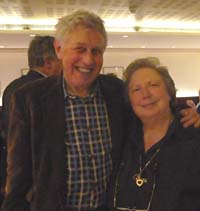
David Matthews and Amelia Freedman
at the post-concert dinner
on 21st November[Amelia Freedman's 70th birthday concert, Wigmore Hall, 21 November 2010]
"There's nothing to hit but the heights. When Kim Criswell made a surprise appearance at Wigmore Hall at the weekend, hair flaming red, body bound in twinkling midnight blue, she made rapid eye contact with one particular woman in the audience, Amelia Freedman - indefatigable commissioner, programmer, impresario, founder-director of the Nash Ensemble and, as Harrison Birtwistle put it, nothing less than the Arsene Wenger of Music - was celebrating her 70th birthday…" Click here to read the whole review.
The Times, November 2010
[20 unmissable events during November 2010]
"Whether as an erstwhile head of classical music at the Southbank, respected festival director, or consummate programmer for her beloved Nash Ensemble, Amelia Freedman has immeasurably enriched musical life. No surprise then that as the Nash plays Ravel, Schubert and Dvorak in honour of her 70th birthday, a distinguished clutch of composers including Birtwistle, Maxwell Davies, Holt and Turnage are obliging with a bouquet of specially-written short pieces"
BBC Music Magazine, October 2010
[Mozart String Quintets - Hyperion CDA 67861/3]
CD of the Week: ***** "Several Nash players - notably its first viola, Lawrence Power, and cellist, Paul Watkins - have important solo careers, but they are first and foremost interpreters of chamber music. The urbane early quintet.. gets an amiable performance, full of high spirits in the Allegro and Minuet. The performances of the four original works.. are magnificently played throughout - conversational, argumentative, profoundly expressive, witty - and rank with the finest ever committed to disc."
The Sunday Times, September 2010
[Theresienstadt Weekend - Wigmore Hall, 19-20 June 2010]
"The greatest musical experiences radically alter our perspectives. This was very much the case with the Nash Ensemble's Theresienstadt weekend. Concerts, films, talks and exhibitions examined the extraordinary cultural flowering in the ghetto-camp near Prague, set up by the Nazis in 1941, where, among thousands of others, the Czech-Jewish intelligentsia were held before transportation to death camps. The event's force lay in its broadening of our contextual awareness, and in its revelation of the quality of the work produced.
Paintings and drawings by children, unflinching witnesses to history, hung on the walls of the Wigmore's subterranean Bechstein room. Three extraordinary women – an actor, a painter and a singer – spoke with wise eloquence of surviving both Theresienstadt and Auschwitz. Creativity was an existential affirmation of life, though traditions died along with people. Krása and Pavel Haas, Janácek's rightful successors, were murdered in the gas chambers. The ironies of Weimar Republic cabaret were kept alive, for a while, in bittersweet songs by Adolf Strauss and Otto Skutecky.
Many works were outright masterpieces. Haas's Four Songs on Chinese Poetry, Erwin Schulhoff's Duo for Violin and Cello, and above all Krása's Passacaglia and Fuga and his Rimbaud settings for baritone, clarinet, viola and cello belong in the regular repertory, irrespective of the circumstances of their composition.
The Nash, an ensemble of stars, played with great technical power and depth of feeling. The singer was Wolfgang Holzmair, richly expressive, if overly score-bound. The Nash should tour this internationally – it deserves to be heard around the world."
The Guardian, June 2010
[Brahms Clarinet Trio & Piano Quartet no.2 - Onyx 4045]
"These are beautifully expressive, thoughtful performances of two unalloyed masterpieces, presented with all the sonic excellence and distinction that we've come to expect from Onyx's series of recordings with the Nash Ensemble. It makes a fine companion to their previous disc of Piano Quartets Nos 1 and 3… it's the account of the account of the Clarinet Trio which which especially impressed me, partly due to the refinement and subtle colouring of Richard Hosford's clarinet playing. The middle movements especially strike me as outstanding, with a wonderful sense of regret and melancholy in the Adagio."
BBC Music Magazine, July 2010
[Brahms Clarinet Trio & Piano Quartet no.2- Onyx 4045]
"The seductive clarinet of Richard Mühlfeld tempted Brahms out of retirement to write his Clarinet Trio and Quintet and one can't help feeling that Richard Hosford's creamy tone - as displayed here - would have proved equally inspirational. An account of an early performance of the Trio said it was 'as though the instruments were in love with one another' - which could equally fit this recording of the Piano Quartet No.2, such is the effortless mastery of the Nash Ensemble."
The Observer, May 10
[Brahms Piano Quartet No.2 - Onyx 4045]
"The splendid performance of the piano quartet shows the young Brahms's intellectual power and melodic abundance to magnificent advantage."
The Sunday Times, May 10
[Invitation au voyage, Wigmore Hall, 6 March 2010]
"The Nash Ensemble absolutely filled the chamber-sized stage of Wigmore Hall and the result was an incredibly rich sound, which filled the hall and our hearts with uplifting music"
Classical Guitar Magazine, April 10
[Brahms String Quintets - Onyx 4043]
"The Nash Ensemble are nothing less than the London regiment of chamber music's crack troops... Both discs present this joyful, compelling music in its best light; the Nash are on cracking form..."
Gramophone, November 09
[Maxwell Davies 75th birthday concert, Wigmore Hall]
"True to its title, 'The Last Island', written for string sextet and played with poised authority by the Nash players who commissioned it, is a journey to a pretty remote outpost... delivered by a group who clearly relished their chance to pay homage to a very genial master."
The Times, October 09
[Maxwell Davies 75th birthday concert, Wigmore Hall]
"'The Last Island' evokes the atmosphere of a mysterious islet off Sanday, where he [PMD] lives. It's a haunting piece, full of glassy harmonics and treacherously exposed string-writing that the Nash players negotiated superbly."
The Guardian, October 09
[BBC Prom No.66, Royal Albert Hall & BBC Radio 3 - George Crumb]
"Haunting performances ensured the music got under everyone's skin. Wonderful."
The Guardian, September 09
[BBC Prom No.66, Royal Albert Hall & BBC Radio 3 - George Crumb]
"The Nash Ensemble certainly made the best possible case for him [Crumb], playing with the same beautiful tone and care for balance that they bring to everything."
The Daily Telegraph, September 09
[BBC Prom No.66, Royal Albert Hall & BBC Radio 3 - George Crumb]
"But the Nash Ensemble, conducted by Diego Masson, revealed his [Crumb's] genuine imagination and lyric fire, especially in 'Ancient Voices of Children', one in a loose cycle of works inspired by the beauty and violence of Lorca's poetry. Claire Booth was on volcanic good form singing into Ian Brown's piano. Philippa Davies's flutes and Paul Watkins's cello made equally effective contributions to the more decorative beauty of 'Night of the Four Moons' and 'Vox Balaenae'."
The Times, September 09
[BBC Prom No.66, Royal Albert Hall & BBC Radio 3 - George Crumb]
"Under Diego Masson's direction, the Nash Ensemble (plus soprano Claire Booth and mezzo Hilary Summers) brought all their artistry to bear on 'Night of the Four Moons', 'Vox Balaenae' (Voice of the Whale)", and Crumb's Lorca-homage 'Ancient Voices of Children', bringing out the full subtlety of his games with timbre and texture."
The Independent, September 09
[Brahms String Quintets - Onyx 4043]
"These Nash accounts are exalted and exalting, alive with subtlety."
The Sunday Times, August 09
[Brahms String Quintets - Onyx 4043]
"These recordings prove that the Nash Ensemble, Britain's peerless chamber group, is in better shape than ever. I can't remember a keener musical pleasure in recent months than hearing violinists Marianne Thorsen and Malin Broman in the allegretto of the F major Quintet, as gracefully entwined as a pair of dancers on an ancient Greek vase. My other favourite moment is the finale of the G major, where the two viola players, Lawrence Power and Philip Dukes, add such subtle swoops to the melody you almost don't hear them. But really, it's all wonderful from beginning to end."
The Daily Telegraph, August 09
"The Nash Ensemble is among the world's great chamber groups, capable of giving its core repertoire the level of grace and insight one more usually associates with excellent string quartets such as the Amadeus or the Budapest." The New Statesman, August 09
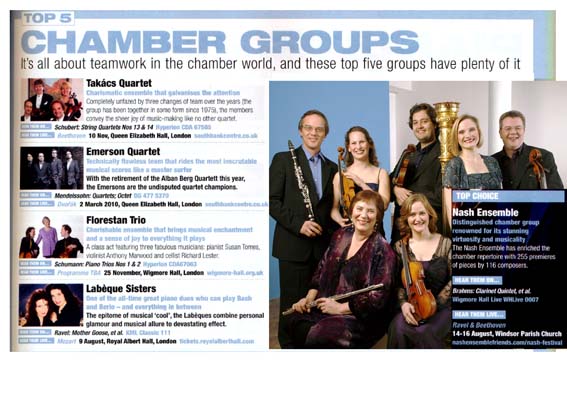
CD OF THE WEEK [Brahms String Quintets - Onyx 4043]
"The Nash achieves immaculate and transparent playing throughout. Violinists Marianne Thorsen and Malin Broman and cellist Paul Watkins step in and out of the limelight as this most democratic of musical combinations demands, but the violas [Lawrence Power and Philip Dukes] are allowed to star. The complex harmonic layers never become heavy or clotted and the recorded sound balance, expertly engineered by Will Brown and produced by Andrew Keener, brings out every hushed pizzicato or syncopation... This is a superb performance: stylish, expansive, imaginative and exuberant."
The Observer, July 09
[Beethoven Chamber Music - Hyperion CDA67745]
"The Nash Ensemble give wonderfully polished performances of all three works, beautifully recorded, but special mention must be made of Ian Brown's piano-playing in the delicious galloping 6/8 rondo finale of the Piano Quartet, totally infectious."
Gramophone, August 09
[Brahms String Quintets - Onyx 4043]
"The Nash achieves immaculate and transparent playing throughout. Violinists Marianne Thorsen and Malin Broman and cellist Paul Watkins step in and out of the limelight as this most democratic of musical combinations demands, but the violas are allowed to star. The complex harmonic layers never become heavy or clotted and the recorded sound balance, expertly engineered by Will Brown and produced by Andrew Keener, brings out every hushed pizzicato or syncopation."
The Guardian, July 09
[Beethoven Chamber Music - Hyperion CDA67745]
"This is a very useful disc and it's beautifully played too... The performance by the Nash Ensemble is very stylish... Recorded sound on this new disc is intimate and realistic - just right for chamber music - and both the performances and the programme deserve a warm recommendation."
International Record Review, June 09
"...the superb musicianship of conductor Lionel Friend and the musicians of the Nash Ensemble (with special kudos to pianist Ian brown and the astonishing harpist Lucy Wakeford): they dug into this thorny program with tremendous vigor and technical command" Washington Post, May 09
[Nash Inventions at Wigmore Hall, 5 March 09]
"Moreover, the Nash Ensemble's concert gave the lie to another piece of received wisdom, in that its five world premieres reflected a new music scene in the rudest health: no one should talk about the impending death of the classical tradition... the Nash Ensemble, for whom all these works were created, is a chamber group beyond compare"
The Independent, March 09
[Nash Inventions at Wigmore Hall, 5 March 09]
"It says much about our perception and consumption of classical music that a concert devoted to six living composers should seem so unusual. In any other medium it wouldn't be, and this Nash Ensemble programme needed no justifying beyond the excellent performances it inspired. Heard together, the seven works added up to far more than the sum of their parts."
The Financial Times, March 09
[penultimate concert of The Nash Ensemble's Wigmore series 'From My Homeland']
"in the intense concentrate of Janacek's 'Kreutzer' Sonata and the lyrical introspection of Brahms's Clarinet Quintet, the playing of Marianne Thorsen, Malin Broman, Lawrence Power, Paul Watkins and Richard Hosford was incisive, transparent and beautifully shaped. Chamber music doesn't come any better."
The Independent On Sunday, February 09
[Brahms Piano Quartets Nos 1 & 3 - ONYX4029]
"This is one of the finest CDs of the past year... Anchored by gigantic virtuosity from Ian Brown at the piano, they give performances that we shall surely still be hearing in 50 years."
The Strad, February 09
[Beethoven String Quintets Op.4 & Op.29 - Hyperion CDA76793]
"Space and clarity abound in flawlessly performed and recorded quintets"
Gramophone, February 09
[Brahms Piano Quartets Nos 1 & 3 - ONYX4029]
"The Nash Ensemble's performers soar through both works as if their lives depend on it. Close, long-term colleagues, these players know each other well enough to relax into the music and let it shine. It's far more unified and natural a rendering than the competing release of all three quartets... the Nash Ensemble players sound as though they love every note."
Classic FM Magazine, February 09
[Beethoven String Quintets Op.4 & Op.29 - Hyperion CDA76793]
"I can't envisage a more satisfying account of these works."
Performance: * * * * *
Recording: * * * * *
BBC Music Magazine, January 09
[Beethoven String Quintets Op.4 & Op.29 - Hyperion CDA76793]
"[The Op.29 Quintet] is a work of conspicuous originality, power and wit (only a little indebted to Mozart and Haydn), as the Nash Ensemble demonstrate in their eloquent, sprightly performance..."
The Sunday Times, January 09
Brahms Piano Quartets Nos 1 & 3 - ONYX4029
"These are terrific, clear-sighted yet impassioned performances of two compelling chamber works, given by a first-rate team of players. In the opening two movements of the G minor piano quartet, composed in 1861, there's a beautiful control of pace and stress, the flavour slightly restrained, though there is certainly plenty of fire in the unrelenting, brilliant gypsy music of the exuberant finale. The C minor quartet, completed in 1874, speaks of darker matter, and was first thought of when Brahms was guiltily preoccupied with thoughts of Clara Schumann. This is an appositely fiery reading"
The Sunday Times, November 08
"Quality shows every time. You only had to glimpse at Thursday's Nash Ensemble team list to realise it is the Chelsea or Manchester United of British ensembles... all amazing soloists in their own right." The Scotsman, June 08
"SUPERGROUP: There was more exceptional musicianship from the Nash Ensemble... Listening to the Nash performing works such as Beethoven's Op.18 No.1 Quartet, Mendelssohn's A minor, Op.17 and Stravinsky's pithy Three Pieces for String Quartet you would assume these musicians were an established quartet rather than soloists in their own right... there is real poetry in their playing... add to this the virtuosity of the playing and the results are exceptional." Glasgow Herald, June 08
"Phillippa Davies [gave] a sensual [performance] of Debussy's Syrinx, and Marianne Thorsen and Paul Watkins a superbly realised performance of Ravel's Sonata for violin and cello" Guardian, April 08
"In all three Dutilleux works the strong sense of mystery alluded to in the presentation prevailed - and in Mystère de l'instant, found a performance proclaimed by the composer to be one of the finest of his works in any time or place." classicalsource.com April 08
"Marianne Thorsen led her three Nash colleagues in a marvellously volatile account, responding to the work's moments of underlying violence. She returned with cellist Paul Watkins to give as passionate reading of Ravel's extended Sonata for violin and cello" The Independent, April 08
"Nash Inventions, it was called: a programme of the newest new music, most of it called into being by the Nash Ensemble. And with strings, piano, flute, oboe, clarinet, horn and harp to play with, it was something of a red-letter evening." The Times, March 08
"Supporting composers by commissioning new work is central to the ethos of the Nash Ensemble. Indeed artistic director Amelia Freedman expects to notch up 140 new commissions by next year, which draws comparisons with Elizabeth Sprague Coolidge - a wealthy US philanthropist who commissioned many leading 20th-century composers. Freedman laughs as she points out that the Nash commissions without access to anywhere near the amount of money Coolidge had at her disposal. Nevertheless, the Nash commitment to new music is huge, as is evidenced in its forthcoming concert Nash Inventions." Classical Music magazine, March 08
Brahms String Sextets Nos 1 & 2 - Onyx "The Nash offer superb new versions, crisp and clear, beautifully coordinated, with plenty of light and shade." Gramophone, September 07
Brahms String Sextets Nos 1 & 2 - Onyx "This is quite possibly the finest coupling of these works we've had in nearly 30 years, and the recording is as richly resonant and opulent as the performances themselves." International Record Review, July/August 07
Mozart Piano Quartets K.478, K.493 - ASV Gold "The Nash are right up there with the leaders in this dazzling Mozart coupling... There have been many fine versions of this favourite coupling but this new offering stands among the finest." Gramophone, July 07
Brahms String Sextets - Onyx Classics "What kind of man loves a married woman, pulls away when she is free, turns to another, then withdraws his proposal after she has accepted it? Brahms's String Sextets, written after his fractures with Clara Schumann and Agathe von Siebold, are among his most revealing works, the first hinting at his crippling insecurity, the second spelling out Agathe's name in its first movement. The Nash Ensemble's passionate reading may be too purple. Occasionally there is a cluttering of texture. Yet the intense, heel of the bow emotionality of this recording is also its most compelling aspect. A red wine, red meat disc from the must-have boutique label." The Independent, 27 May 07
A Flute Sparkles in Mozart's Spirited, Rent-Paying Quartet
"Chamber music ensembles can sometimes seem like poorly arranged marriages, with a dynamic that doesn't quite work. But the members of the Nash Ensemble from London, who performed at the 92nd Street Y on Wednesday, were collegial and dynamic, attuned to one another (and in tune) throughout a wide variety of repertory...
The Nash Ensemble champions the British composer Mark-Anthony Turnage, whose visceral music often hints at jazz influences. On Wednesday it played his dreamy, subtle "Three Farewells"...
The harp, which has a small role in the Turnage work, takes center stage in the sensually colored Introduction and Allegro for Flute, Clarinet, Harp and String Quartet by Ravel, a fan of the instrument. The Nash gave a stellar performance, with Lucy Wakeford, the harpist, playing the rippling arpeggios and evocative solo with finesse.
Debussy, unlike Mozart, never professed a dislike for the flute. The lights onstage dimmed for his fleeting "Syrinx" for Solo Flute, in which Ms. Davies evoked a pastorally meditative atmosphere.
Then it was on to a very different sound world with Mendelssohn's youthful String Quartet No. 2 in A minor, Op. 13, here given a fine reading that was bristling and passionate, lyrical and graceful. There was a lot of smiling onstage, and the Nash's enthusiasm was contagious."
New York Times, 26 March 07 click here to view entire review
Nash Ensemble Premieres the Alluring 'Terrible Beauty,' Inspired by the Bard "London's celebrated Nash Ensemble is a collective of players who form and regroup for varied chamber music programs. Particularly noted for its commitment to enlarging the repertoire for mixed ensembles, the Nash has championed 255 new works over its long history, nearly half of them commissions. On Tuesday evening at the Kennedy Center's Terrace Theater, the Nash gave us one of the finest chamber music concerts of the season, both in programming and execution... The evening was a triumph" Robert Battey, Washington Post, 22 March 07 click here to view entire review
Strauss: Metamorphosen; Piano Quartet in C minor; Prelude to Capriccio
Nash Ensemble - Hyperion CDA67574
"The playing has those many attributes you would expect from the Nash Ensemble, among them immaculate intonation and fluid tempos that allow the music to flow in long, unbroken phrases... When composing the Metamorphosen for 23 solo strings, Strauss had used a short score for string septet, almost certainly never intending it to be performed in that format. Itwas redicsovered in 1990 and subsequently published... Here it emerges as a very sad work, the Nash strings producing a gorgeous and velvety smooth sound."
David Denton, The Strad, April 07
Strauss: Metamorphosen; Piano Quartet in C minor; Prelude to Capriccio
Nash Ensemble - Hyperion CDA67574
"Reducing the string size of Strauss's Metamorphosen from 23 to the seven of the composer's short score, as Rudolf Leopold did in the 1990s, might seem to be going light on the tragic force of this great wartime elegy. Not so in the hands of the Nash Ensemble. If anything Strauss's most private moments of grief have even more eloquence, especially as they attempt to shy away from the monumental waves of emotion that threaten to engulf the memorial's closing stages... Truthful recording does full justice to the warmth, poise and integration of these marvelous performances."
Performance: *****
Sound: *****
David Nice, BBC Music Magazine, March 07
Realms of Gold at Wigmore Hall on Saturday 17 February 2007 "If it has demonstrated nothing else, the Nash's Realms of Gold series, highlighting Elgar and the British composers who succeeded him, has shown the range of a repertoire still stigmatised as parochial... the performers' precise interplay continued throughout an imaginative programme that was executed with distinction." George Hall, The Guardian, 20 Feb 07
Strauss: Metamorphosen; Piano Quartet in C minor; Prelude to Capriccio
Nash Ensemble - Hyperion CDA67574
[Metamorphosen for solo strings] "...I am lost in admiration at The Nash Ensemble's achievement here in capturing the music's noble intensity with an emotional flexibility and glowing textural fluidity denied even Karajan's sensational Berlin players at their most refulgent.
Captured in immaculately balanced, velvety sound by producer Andrew Keener and engineer David Hinitt, this is a performance that gets right to the heart of this glorious score, tantalisingly retaining its chamber-scale purity even when Strauss is at his most super-heated. There are magic moments galore along the way, but to hear Marianne Thorsen (ravishing portamentos) and her fabulous team soar aloft with the pulsating phrases that briefly resolve at 16'48" is an unforgettable experience. The Prelude to Capriccio, Strauss's sublime operatic swan-song, also makes an indelible impression in this sensitive performance."
International Record Review, Feb 07
Strauss: Metamorphosen; Piano Quartet in C minor; Prelude to Capriccio
Nash Ensemble - Hyperion CDA67574
"This captivating disc from the Nash Ensemble features music from both ends of Richard Strauss's long and productive life. The Piano Quartet in C minor is a product of the 21-year-old composer's infatuation with the music of Brahms. In its own way it is a remarkable piece - as one early critic quoted in the booklet noted, it shows Strauss "a better Brahmsian than Brahms" - with a hint of the sweeping, ardent melodies of the high-Romantic Strauss to come. The Nash players certainly give it their all and make one wonder why it's not better known.
More familiar is Strauss's great late lament Metamorphosen, but it is played here in a realisation of his original draft for seven strings rather than the 23 he eventually settled upon. With a performance as searing as this, it makes just as much of a mark as the better-established "orchestral" version - the textures sound just as full, yet the intertwining lines emerge with greater focus and the whole is underlined by the tonal solidity of Duncan McTier's double bass. An equally seductive account of the string sextet Prelude to Capriccio completes the programme."
The Daily Telegraph, 27 Jan 07
Realms of Gold at Wigmore Hall on Saturday 20 January 2007 "These Nash musicians live gold. They play gold. They just don't earn it. Time and again we heard the group trademarks: warm colouring, perfect balance, a miraculous ensemble sense, exquisite but never bloodless taste... the Bliss Oboe Quartet, with Hulse again, delivered with ease: more realms of gold. And a packed house. I hope for the same at the all-contemporary Nash Inventions concert in March." Geoff Brown, The Times, 25 Jan 07 click here to view entire review
>Nash Ensemble Realms of Gold Series/John Mark Ainsley 20 Jan 2007 "A beautifully balanced programme and, yet again, a packed Wigmore Hall." Bayan Northcott, The Independent, 24 Jan 07 click here to view entire review
Realms of Gold at Wigmore Hall on Saturday 20 January 2007
Traversing England's Musical Landscape
"The Nash Ensemble, under the artistic directorship of the indefatigable Amelia Freedman, has always led where others follow in terms of inspired and resourceful programme planning.
This season's Wigmore Hall concerts, for example, are exploring the early 20th-century British repertoire with a characteristic mix of the well-known and unfamiliar. The peg, as if any were really needed, is the 150th anniversary of Elgar's birth...
Peter Warlock's death-imbued Yeats setting The Curlew for flute, cor anglais and string quartet. Tenor John Mark Ainsley brought the acute detail of word-awareness and silvered tonal delivery for which he is renowned to Warlock's music.
He also shone in that other great chamber song cycle from the early 20th century, Vaughan Williams's On Wenlock Edge, charting the bitter irony of A E Housman's "Is My Team Ploughing?" with searing intensity.
This wonderful piece also allowed the Nash's string players to shine, especially in the atmospheric expanses of "Bredon Hill", with its troubling transformation, in the string harmonics, of the hazy bells of summertime into the sombre tolling of winter."
Matthew Rye, The Daily Telegraph, 23 Jan 07 click here to view entire review
Mendelssohn: Piano Trios, Variations Concertantes "The Nash give thoroughly sympathetic performances, keeping the textures lucid and shaping Mendelssohn's sumptuous tunes with subtlety and grace." The Daily Telegraph, 6 Jan 07
Nash Ensemble: Realms of Gold "The Nash Ensemble seems incapable of giving anything less than a first-rate performance. The regular line-up of musicians is now stronger than it ever has been and, together with the imaginative and carefully thought out programmes, makes Nash concerts unmissable." Michael Allen, classicalsource.com 10 Oct 06
Nash Ensemble at Wigmore Hall, 4 December 2006
Concert: Nash Ensemble * * * * *
"Call me mad or fanciful, but sitting in the packed Wigmore Hall, 30 years after Benjamin Britten's death, I felt a real sense of the composer's spirit infusing the performers who delivered this superlative evening of his vocal music... the string players of the Nash Ensemble, under Edward Gardner's direction, matched her [Lisa Milne] for fervour, digging their bows deep into the raw opening fanfares and maintaining this exhilarating energy to the last... Mark Padmore's account of the Serenade for Tenor, Horn and Strings - magnificently enhanced by Richard Watkins's virtuosic horn-playing - brought me close to tears (for the right reasons, I hasten to add)."
Richard Morrison, The Times, 6 Dec 06
Nash Ensemble at Wigmore Hall, 4 December 2006
Britten and his many loves
"The brilliance of Britten's writing for strings was further emphasised in the Nash Ensemble's performance of Les Illuminations, Phaedra and the Serenade for Tenor, Horn and Strings under Edward Gardner. Heard in the Wigmore's perfect acoustics and played by small ensemble of indisputable virtuosi these were almost overwhelming. Biting violins, intoxicating violas, warm cellos and fervent double-basses magnified the opulence of Rimbaud's words and Britten's dazzling orchestration."
Anna Picard, The Independent, 10 Dec 06
St Magnus Festival* * * * * "Ravel's lovely Introduction and Allegro and Maxwell Davies's less well-known but equally elegant Dove, Star-Folded were followed by a peerless F Minor Piano Quintet by Johannes Brahms, its military scherzo and wonderfully constructed finale given a performance absolutely out of the top drawer." Keith Bruce, Glasgow Herald, 22 July 06
Head rules the heart in Schumann celebration "Amelia Freedman was in the audience for this concert. This in itself was not unusual, since, as head of music on the South Bank for more than a decade, she has been a familiar figure fondly respected and admired at countless events. But the Philharmonia Orchestra, in dedicating this programme to her as she relinquishes the post offered a timely salute for all that she has done at the Festival Hall and its satellite venues to consolidate the musical programming, keeping it constantly alive and injecting it with fresh ideas in the many award-winning series that have not merely taken place under her aegis but were actually the fruits of her own imagination. Her wise and genial counsel on the South Bank will be greatly missed, for, aside from her obvious skills, she managed to achieve the almost impossible feat of maintaining friendships across a whole spectrum of the musical profession with composers, performers, impresariois - and even with us journalists." Geoffrey Norris, The Daily Telegraph, 5 July 06
The Nash Ensemble sets the benchmark for Brahms "...the Nash Ensemble's glorious Wigmore Hall performance from last October of the Brahms... it's a thoughtful, supple reading marked by a wonderful sense of teamwork, with Richard Hosford's fluid clarinet subtly embedded in the overall sound, and some magical string sonorities, especially in the muted slow movement... With some typically imaginative Nash programming, the Brahms is complemented by Schumann's delightful Fairy Tales for clarinet, viola and piano, and an enjoyable rediscovery by Mendelssohn's mentor Ignaz Moscheles, based on a Bohemian folk song. Fine performances, especially from Ian Brown..." BBC Music Magazine, May 06
Nash Ensemble * * * * * "In an exceptional concert consisting entirely of its own commissions, the Nash Ensemble showed why they are among today's most outstanding and enterprising groups." Paul Conway, The Independent, 27 March 06
"After 40 years and 250 premieres, the Nash Ensemble is till the best champion that any composer could hope to have. Its concerts are always meticulously polished, but what most impressed about this heroically well-stuffed programme - two premieres and four other chamber pieces, none more than four years old - was the illusion conjured by these players that they have lived with this music for years, even if the ink was barely dry on the page. Perhaps it is precisely because this ensemble is not entirely dedicated to doing contemporary work that it can radiate so persuasive a feeling of new pieces being assimilated into a chamber-music heritage stretching back two centuries or more." Richard Morrison, The Times, 24 March 06